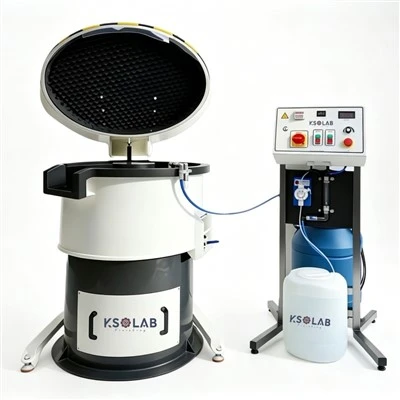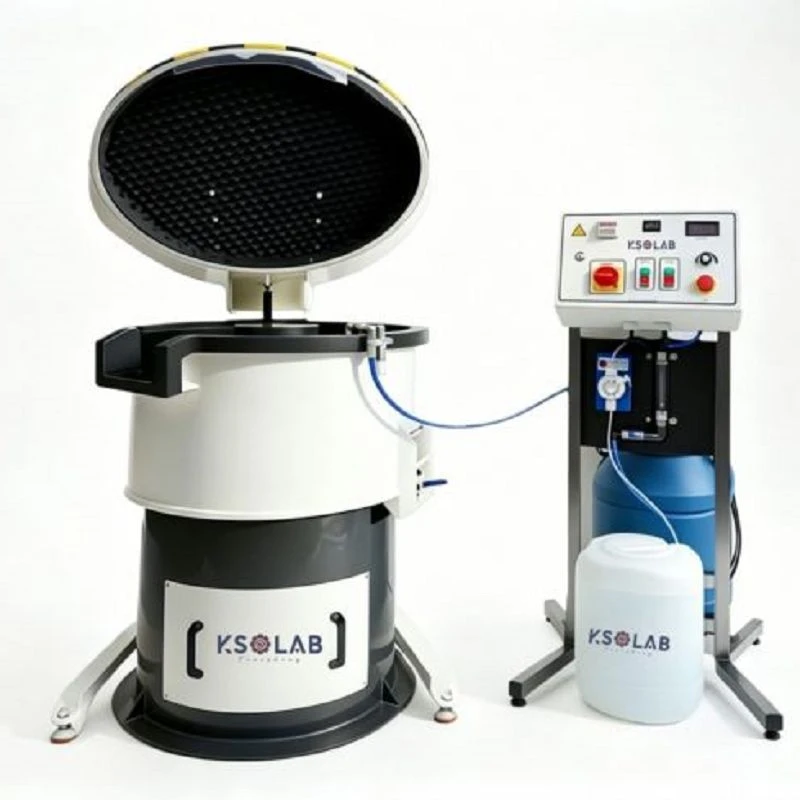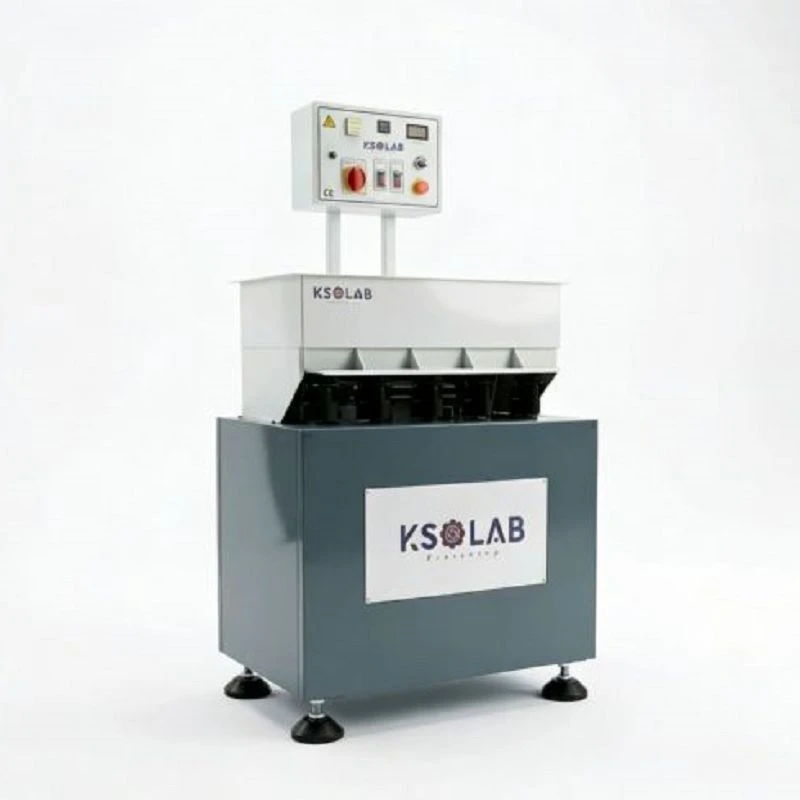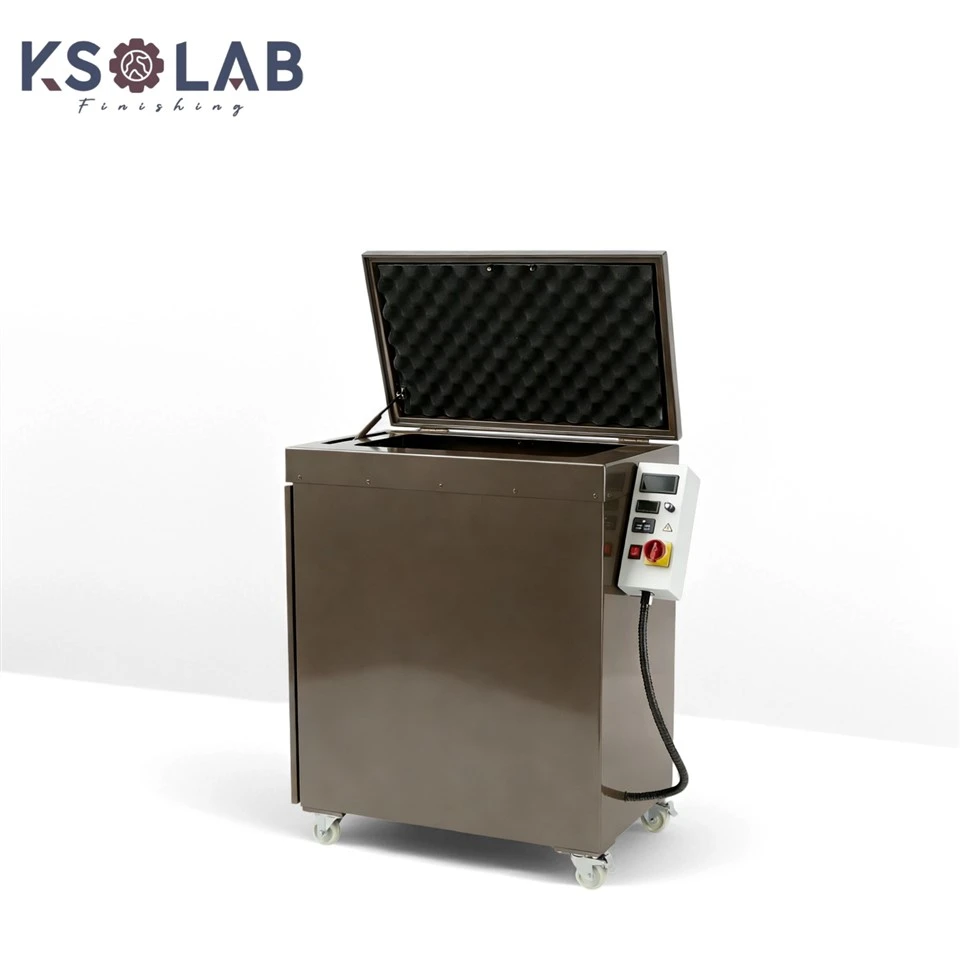
In industrial production, many metal or non-metal products often have burrs, scratches, oxide scale, or uneven surfaces after forming. To improve the product's appearance, enhance its performance, or prepare for subsequent coating treatments, surface grinding and polishing are indispensable processes. Traditional polishing methods, such as manual grinding, are not only inefficient and inconsistent but also require highly skilled operators and are labor-intensive. With the increasing demands for efficiency and quality in the manufacturing industry, automated and high-efficiency surface treatment equipment has emerged, among which the tumbler polishing machine is a widely used and highly effective piece of equipment.
Tumbler polishing machines, sometimes called tumble burners or centrifugal polishing machines, work on the core principle of using the rotational motion of the tumbler to create continuous, relatively random tumbling and friction between the workpiece and the abrasive media within the tumbler, thereby achieving surface grinding, deburring, chamfering, and polishing effects. This process can be imagined as placing the workpiece, along with specific abrasives, polishing agents, and water, into a closed drum. As the drum rotates, the internal mixture tumbles, slides, and collides under the influence of centrifugal force and friction. The abrasives perform micro-cutting on the workpiece surface, ultimately achieving a smooth and shiny finish.
So, how exactly does a drum polishing machine work? And what types of workpieces can it handle? We can understand this through the following key components:
1. Core Structure and Workflow
A typical drum polishing machine mainly consists of a drive motor, a drum body, a frame, and a control system. The drum is usually made of wear-resistant polyurethane, rubber, or a metal-lined wear-resistant material. Its internal shape may be designed as circular, hexagonal, or polygonal to promote better material tumbling. During operation, the operator loads a specific ratio of workpiece, grinding media (such as ceramic triangular stones, plastic granules, high-alumina ceramics, etc.), and an appropriate amount of water or polishing fluid into the drum, closes the chamber door, and sets the rotation speed and time. After startup, the drum rotates at a constant speed driven by the motor, and the internal mixture moves accordingly. After a set time, the workpiece is removed, cleaned, and separated to obtain a product with a smooth surface.
2. Applicable Workpiece Types and Industries
While drum polishing machines are not high-quality, they are very versatile. They are particularly suitable for processing large quantities of small, relatively simple parts that are not easily tangled or damaged by impact. For example:
* Fasteners: Deburring and polishing of screws, nuts, and bolts.
* Hardware Accessories: Locks, hinges, handles, cutlery, and knife blanks.
* Mechanical Parts: Gears, bushings, stampings, and precision mold parts.
* Jewelry and Crafts: Pre-polishing of metal ornaments, badges, and commemorative coins.
* Medical Device Components (Non-Implantable): Surface treatment of surgical instrument accessories and stainless steel utensils.
* Electronic Product Parts: Deburring of mobile phone frames, heat sinks, and connectors.
3. Selection of Abrasive Media
The selection of abrasive media directly affects the final processing effect. Media are categorized by material, shape, and size, and their main functions include cutting, grinding, polishing, and finishing. For example, ceramic media, with its high hardness, is mainly used for deburring and rough grinding; plastic media, with its softer texture, is often used for fine polishing and gloss finishing; while steel balls provide strong cutting force and are used for heavy-duty descaling. Selecting the appropriate media combination based on the workpiece material and initial surface condition is a crucial step.
Why has the tumbler polishing machine become an important part of industrial surface treatment? What specific advantages does it offer?
In terms of efficiency, tumbler polishing machines achieve automated batch processing. Thousands of small parts can be placed in a single tumbler, and all workpieces can be processed in a single run. Compared to manual operation, production efficiency is increased by tens or even hundreds of times, making it particularly suitable for large-scale standardized production.
It has a significant advantage in the consistency of processing results. The machine operates according to preset parameters, providing almost identical processing environments and times for all workpieces within the tumbler, thus ensuring a high degree of uniformity in the surface quality of the entire batch of workpieces and effectively avoiding quality fluctuations caused by differences in force and technique during manual operation.
Furthermore, it has strong adaptability. By adjusting the drum speed, processing time, type and ratio of abrasive media, and adding different polishing compounds, a single machine can handle various process requirements, from heavy-duty deburring to mirror polishing, achieving "one machine for multiple uses."
From an economic and environmental perspective, it reduces reliance on skilled workers and lowers labor costs. The enclosed operation effectively controls dust and noise dispersion, improving the workshop environment and meeting modern clean production requirements.
Of course, every piece of equipment has its applicable scope and limitations. When processing particularly precise threads, complex parts with deep holes or grooves, and soft materials prone to impact damage (such as aluminum and copper), drum polishing machines may require careful process adjustments or consideration of alternative polishing methods.
In practical applications, how can we ensure that drum polishing machines achieve ideal results? What are the key points to note during operation?
Controlling process parameters is crucial. The rotational speed of the drum needs to be precisely set: if the speed is too high, the workpiece and medium will slide against the drum wall due to centrifugal force, weakening the tumbling friction and reducing the polishing effect; if the speed is too low, the material will not be lifted high enough, resulting in weak impact force and low efficiency. There is usually a "preferred speed" range that allows the material to achieve a desirable tumbling state.
The loading volume needs to be planned reasonably. The total volume of the workpiece, medium, and liquid should ideally occupy 60% to 75% of the effective drum volume. Overloading will hinder material flow and lead to uneven processing; underloading will result in insufficient friction, low efficiency, and may cause workpiece collision damage.
Managing the processing time requires experience. Insufficient time will result in inadequate surface treatment; excessive time may lead to over-cutting of the workpiece, dimensional errors, or a decrease in the achieved surface finish due to excessive impact. Process trials are usually needed to determine the preferred processing cycle for different products.
Subsequent separation and cleaning processes are not to be overlooked. After processing, the workpiece and abrasive media remain mixed together, requiring efficient separation screens for sorting. The workpiece must then be thoroughly cleaned and dried to prevent residual abrasive or compounds from affecting subsequent processes or use.
Tumble polishing machines, as a classic surface treatment device, continue to play a vital role in numerous industrial manufacturing sectors due to their high efficiency, stability, adaptability, and ease of batch processing. They represent the replacement and upgrade of traditional manual operations by mechanized and automated production, and are an effective tool for improving the surface quality of industrial products, ensuring production efficiency, and product consistency. With advancements in materials science and automatic control technology, future tumble polishing equipment may further develop in energy efficiency control, process intelligence, and online monitoring, providing more reliable and refined surface treatment solutions for industrial manufacturing.